|
|
Wisdom teeth are the third and final set of molars that most people get in their
late teens or early twenties. Sometimes these teeth can be a valuable asset to the
mouth when healthy and properly aligned, but more often than not, they are misaligned
and require removal.
|
|
|
|
|
|
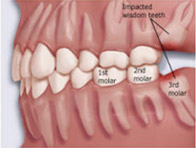
Wisdom teeth present potential problems when they are misaligned as they can position
themselves horizontally, be angled toward or away from the second molars or be angled
inward or outward. Poor alignment of wisdom teeth can crowd or damage adjacent teeth,
the jawbone or nerves. Wisdom teeth that lean toward the second molars make those
teeth more vulnerable to decay by entrapping plaque and debris. Teeth that remain
partially or completely entrapped within the soft tissue or the jawbone are termed
"impacted". Wisdom teeth that only partially erupt allows an opening for bacteria
to enter around the tooth and cause an infection, which results in pain, swelling,
jaw stiffness and general illness. Partially erupted teeth are also more prone to
tooth decay and gum disease because their hard-to-reach location and awkward positioning
makes brushing and flossing difficult.
|

|
How do I know if I have wisdom teeth?
|
|
|
Ask your dentist about the positioning of your wisdom teeth. He or she may take
an X-ray periodically to evaluate the presence and alignment of your wisdom teeth.
Your dentist may also decide to send you to an oral surgeon (also called an oral
and maxillofacial surgeon) for further evaluation.
Your dentist or oral surgeon may recommend that your wisdom teeth be extracted even
before problems develop. This is done to avoid a more painful or more complicated
extraction that might have to be done a few years later. Removal is easier in young
people, when the wisdom teeth roots are not yet fully developed and the bone is
less dense. In older people, recovery and healing time tend to be longer.
|
|
|
Are wisdom teeth meant to be extracted?
|
|
|
Not always. Wisdom teeth (the third molars) are the back teeth on either side of
each jaw and normally appear between 17 and 25 years of age. More often since there
is scarcity of space for them to emerge in the right position, they get stuck in
the bone in all possible angulations. Such a situation frequently causes pain radiating
to the ear or lower jaw, infection in the tissues surrounding the tooth and recurrent
tooth decay due to inaccessibility to maintain hygiene. Only then is it justified
to get them removed. If the wisdom teeth have erupted normally without any hassles,
you don't need to bother about them.
|
|
|
How are wisdom teeth removed?
|
|
|
The relative ease at which your dentist or oral surgeon can extract your wisdom
teeth depends on their position. Your dentist will be able to give you an idea of
what to expect during your pre-extraction examination. A wisdom tooth that is fully
erupted through the gum can be extracted as easily as any other tooth. However,
a wisdom tooth that is underneath the gums and embedded in the jawbone will require
an incision into the gums and then removal of the portion of bone that lies over
the tooth. Often, for a tooth in this situation, the tooth will be extracted in
small sections rather than removed in one piece to minimise the amount of bone that
needs to be removed to get the tooth out.
|
|
|
How long will it take to recover?
|
|
|
Normal healing after tooth extraction should be as follows: The first two days after
surgery are generally the most uncomfortable and there is usually some swelling.
On the third day you should be more comfortable and, although still swollen, can
usually begin a more substantial diet. The remainder of the post-operative course
should be gradual, steady improvement. If you don't see continued improvement, please
call our office.
|
|
|
Is swelling post surgical removal of the impacted tooth common?
|
|
|
The swelling is normally expected after surgical removal of impacted tooth and it
is usually proportional to the surgery involved. There is usually a fair amount
of cheek retraction involved with the removal of impacted wisdom teeth which is
accompanied by bone grinding. Therefore, you should expect swelling of the cheek
after your surgery.
The swelling will not become apparent until the day following surgery and will not
reach its maximum until 2-3 days post-operatively.
The swelling may be minimized by the immediate use of ice packs.
The ice packs should be applied 20 minutes on/20 minutes off for the afternoon and
evening immediately following your extraction. After 24 hours, ice has no beneficial
effect
|